

for software and AI-service teams running 3+ agents
Every agent starts
with the right context.
ValorBrain keeps decisions, facts and documents for every project and client in shared memory. Each agent gets what it needs, with the right source and permissions.
- Claude Code
- Codex
- OpenClaw
- Hermes
- and other agents through MCP and API
- Sourced answers
- Per-person permissions
- Data in Brazil · LGPD
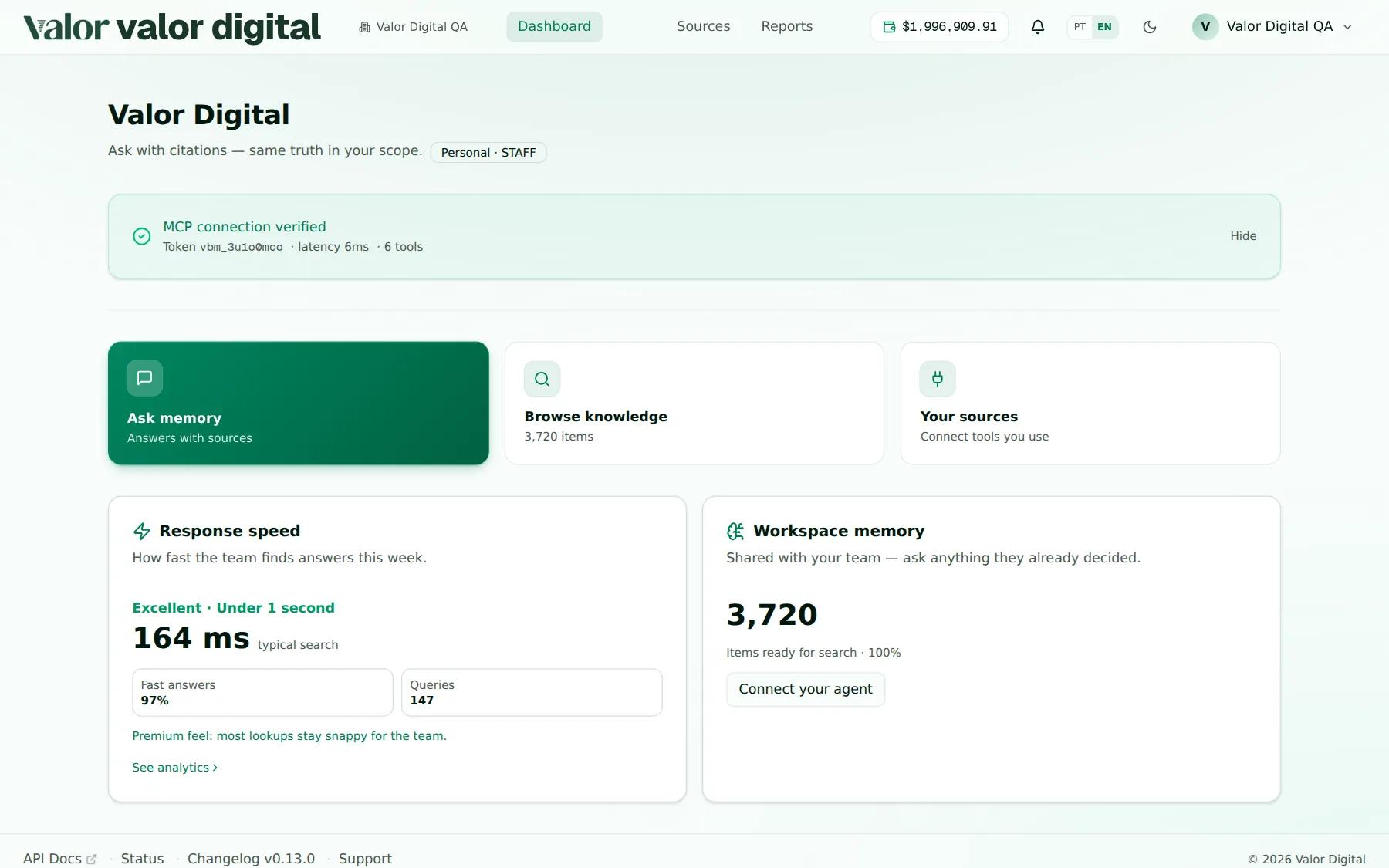
See a sourced answer in 40 seconds.
One question, the retrieved context and the document behind the answer. No narration.
Many agents. One shared context.
With three or more agents, context becomes infrastructure. Decisions, client scope and permissions must stay consistent when the tool changes.
- Each agent gets a different briefingEvery agent starts from the same current decisions
- Client context stays trapped in chats and peopleEach project and client keeps its own shared context
- An old document quietly becomes the answerSources stay visible and conflicting versions are flagged
- Access rules have to be rebuilt in every toolThe agent inherits the permissions of the person using it
Connect. Scope. Deliver.
Memory follows the work across projects, clients and agents without erasing access boundaries.
Connect
Start with the material you already have.
- Google Drive, Notion, GitHub, Linear and Slack
- Documents, transcripts and REST API
- No data-modelling project before the first answer
Scope
Keep each project and client in the right boundary.
- Shared or private sources
- Roles and permissions inherited by the agent
- Conflicting versions flagged before they become context
Deliver
Give the same current memory to every connected agent.
- Context through MCP and API
- Source attached so the answer can be checked
- Decisions written back for the next agent
broad compatibility
The context stays when the agent changes.
Claude Code, Codex, OpenClaw and Hermes are familiar examples. The same memory is also available to other agents through MCP and API.
- Same context
Agents retrieve the same current decisions for the project or client.
- Right scope
Each agent receives only the material allowed for that person and source.
- Visible source
The source travels with the answer, and conflicting versions do not pass silently.
published evidence
What the benchmarks actually measure.
LoCoMo measures whether the right evidence reaches the top 10. BEAM-100K measures the end-to-end answer across sessions. Isolation, permissions, and handoffs are outside these scores.
- 96.58% evidence recall@10 on LoCoMo. +2.1 pp vs published open-source leader (94.5%)
- 80.8% end-to-end binary accuracy on BEAM-100K (323/400 correct across 20 conversations; reader GLM-5.3 Flash (Ox Alpha); judge GLM-5.2; effort=max; run 2026-08-23; ~44% slower than default effort; this benchmark setup is not the chat default)
Start with one project. Expand later.
Documents, memory and search are unlimited on paid plans. You pay for people and AI answers. Business free for 14 days, no card.
- Free$0
100 answers/mo
100 answers/mo1 - Solo$20
500 answers/mo
500 answers/mo1 - Team$59
2,000 answers/mo
2,000 answers/mo10 - BusinessPopular$249
10,000 answers/mo
10,000 answers/mo50 - EnterpriseCustom
unlimited answers
unlimited answersunlimited
Need more people, on-premise or a 99.9% SLA? Enterprise is negotiated. See full pricing →
Questions
What a team with several agents needs to know before trying it.
What problem does ValorBrain solve?
Which agents can use it?
Who gets the most value from it?
How much does it cost?
Where is our data stored, and who can see it?
How long until we can test the first answer?
Can we cancel whenever we want?


Stop re-explaining the work
to every agent.
Connect one project and bring the same context to the agents your team already uses. Business free for 14 days, no card.